New Kingdom
Hatshepsut (Maatkare)
18th Dynasty · 1550-1295 BCE
 Open full-size illustration →
Source: Shaw, Oxford History of Ancient Egypt (2000)
Background
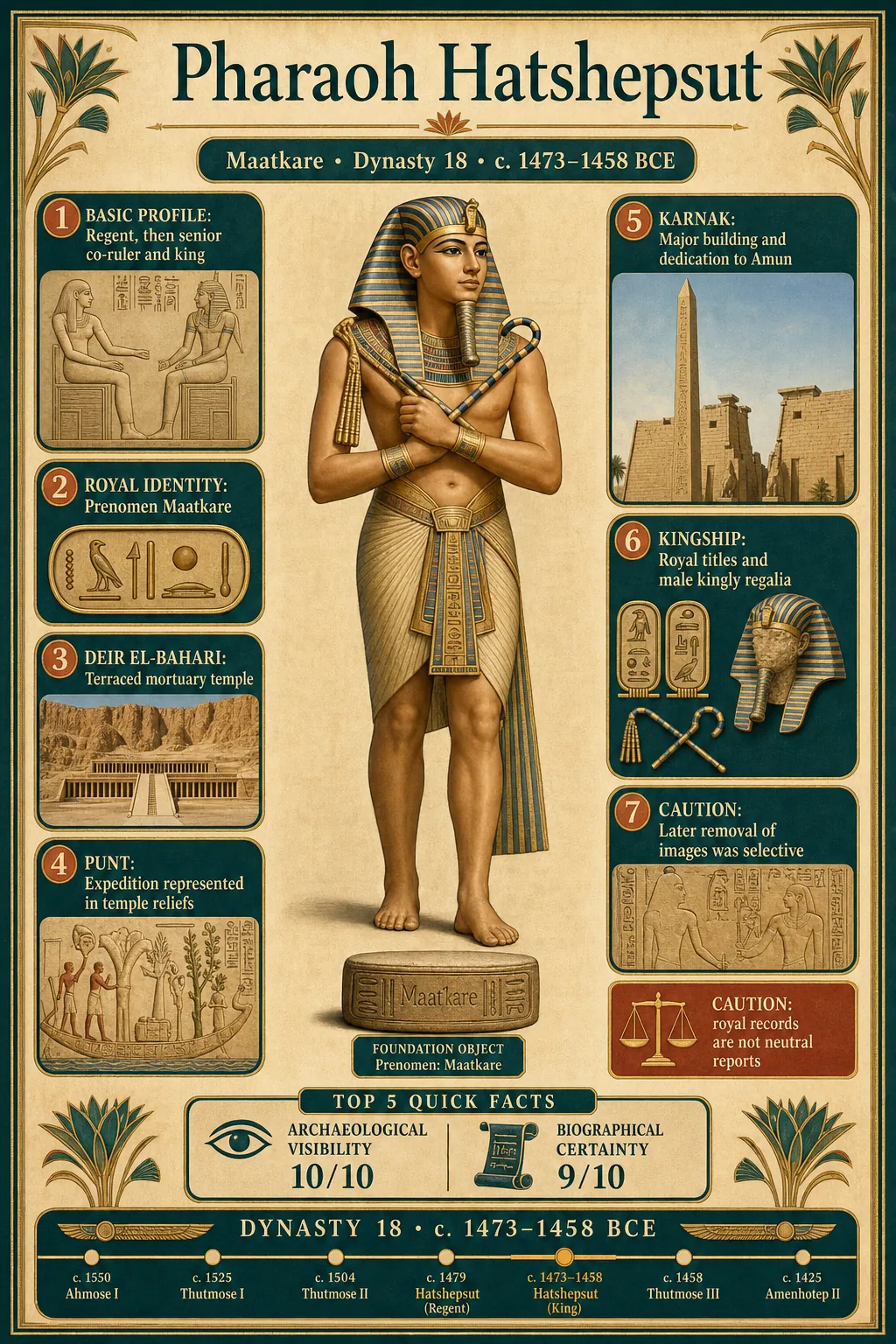
Hatshepsut, throne name Maatkare, began ruling as regent for her infant stepson Thutmose III before assuming the full titles and iconography of a pharaoh in her own right, one of very few women in Egyptian history confirmed to have done so. Her roughly two-decade reign is unusually well documented through monumental building, trade expeditions, and administrative records, and unusually complicated by a later, still-debated campaign to erase her name and image from public monuments. Research: UCL Digital Egypt; Metropolitan Museum; Hawass et al. (2007).
Dating: Shaw, Oxford History of Ancient Egypt (2000)
Full profile
Overview
Hatshepsut (throne name Maatkare) was one of the most successful rulers of the 18th Dynasty. She began as regent for her infant stepson Thutmose III around 1479 BCE and, by about Year 7, had taken the full status and titles of pharaoh, reigning for roughly 22 years until her death around 1458 BCE.
Lineage & family
- Father: Thutmose I
- Mother: Queen Ahmose
- Grandmother: Ahmose-Nefertari, a revered figure who established the title "God's Wife of Amun"
- Husband (half-brother): Thutmose II
- Daughter: Neferure, God's Wife of Amun, who died around Year 15
- Stepson and co-ruler: Thutmose III, who inherited the throne as a two-year-old infant
Key associates
- Senenmut: chief architect, steward and tutor to Neferure, who oversaw her major monuments. A romantic relationship with Hatshepsut has often been suggested, but the evidence — workmen's graffiti and hidden carvings in her temple — is circumstantial.
- Ineni: a courtier who recorded events of the early regency.
Achievements & events
- Divine legitimacy: she promoted a "divine birth" narrative, claiming the god Amun had visited her mother to conceive her.
- Iconography: she adopted male pharaonic regalia (false beard, kilt) to satisfy the theological requirement that the king embody the male god Horus — a matter of role, not personal identity.
- Expedition to Punt (around Year 9): a fleet of five ships reached the "Land of the Gods" (probably the Horn of Africa), returning with live myrrh trees, frankincense, gold and exotic animals.
- Military campaigns: despite a reputation for a peaceful reign, campaigns were mounted into Nubia (notably Year 12) and Canaan.
Monuments
- Deir el-Bahari: her celebrated terraced mortuary temple on the West Bank at Luxor.
- The Red Chapel: a red quartzite shrine at Karnak for the Opet Festival.
- Obelisks: quarried at Aswan and raised at Karnak.
- Speos Artemidos: a rock-cut temple dedicated to the lioness goddess Pakhet.
Death & discovery
- The leading interpretation is that she died around age 55, with evidence pointing to bone cancer alongside diabetes and severe dental disease, though the exact cause is not settled.
- Mummy identification (2007): a team led by Zahi Hawass identified her mummy in KV60 (the tomb of her wet nurse); the identification rested on matching a loose molar in a canopic box bearing her name to a socket in the mummy's jaw.
- Erasure: her monuments were later systematically defaced and her name removed. This now looks less like an act of jealousy by Thutmose III and more like a calculated, later political move — continued under Amenhotep II — to secure the male line of succession.
Research: after Shaw, Oxford History of Ancient Egypt; Hawass et al. (2007).
Sources for this profile
- Baker, D. D. (2008). The Encyclopedia of the Pharaohs: Volume 1. Stacey International.
- Shaw, I. (Ed.). (2000). The Oxford History of Ancient Egypt. Oxford University Press.
- University College London. Kings of the New Kingdom.
- Reeves, N., & Wilkinson, R. H. (1996). The Complete Valley of the Kings. Thames & Hudson.
- Dodson, A., & Hilton, D. (2004). The Complete Royal Families of Ancient Egypt. Thames & Hudson.
The complete, APA-formatted reference list is on the Academic Sources & Bibliography page.