Old Kingdom
Khufu (Cheops)
4th Dynasty · 2613-2494 BCE
 Open full-size illustration →
Source: Shaw, Oxford History of Ancient Egypt (2000)
Background
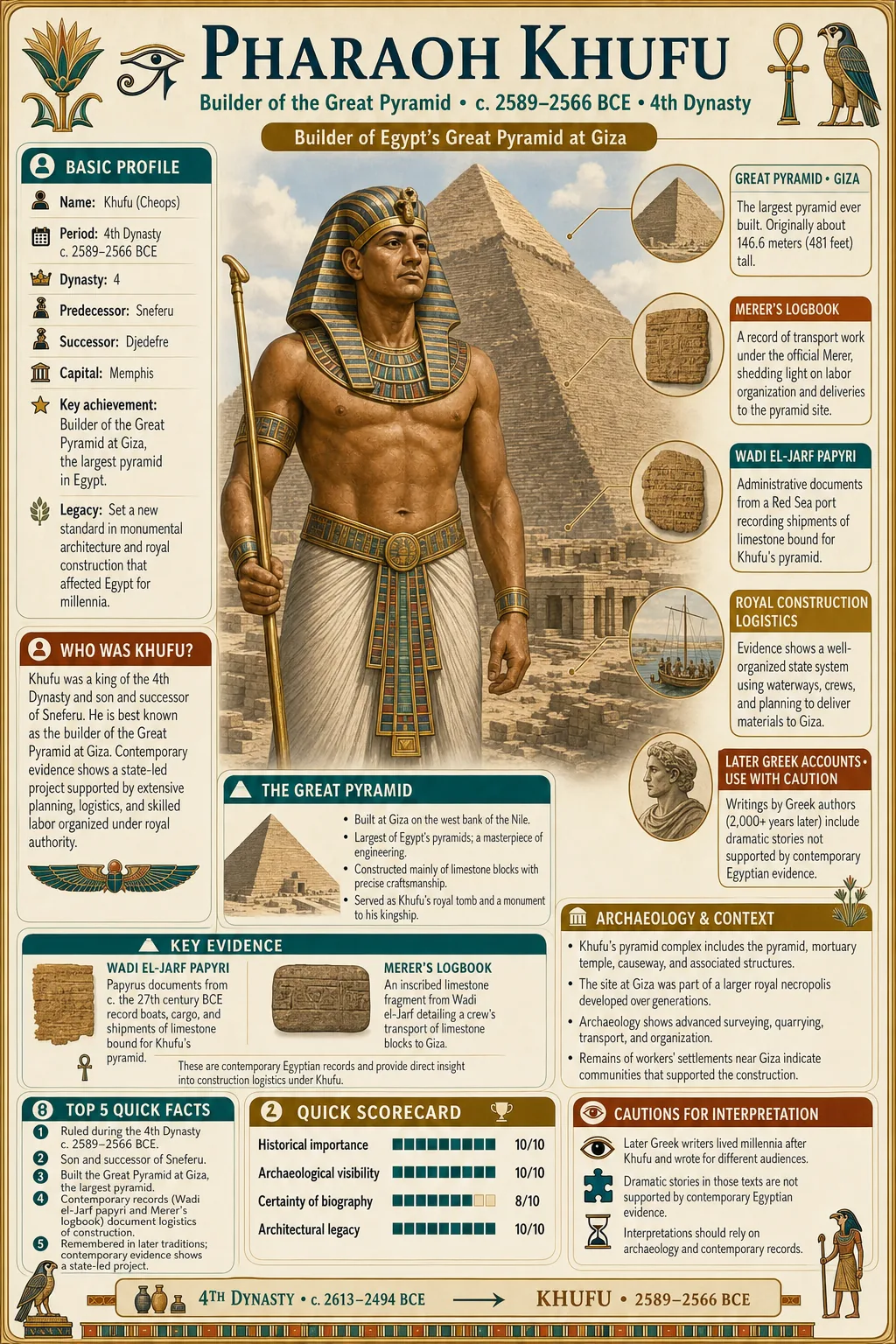
Khufu, Sneferu’s son and successor, built the Great Pyramid at Giza, the largest Egyptian pyramid. His reign is illuminated not only by the monument but also by the Wadi el-Jarf papyri, including Merer’s logbook, which records transport work connected with limestone deliveries to Giza. These documents give rare contemporary insight into the logistics of royal construction. Later Greek writers created a harsh portrait of Khufu, but those accounts were composed millennia after his reign and should not outweigh contemporary evidence. His pyramid complex and royal cult demonstrate the reach of Fourth Dynasty kingship. Research: Metropolitan Museum; Wadi el-Jarf papyri.
Reign dates: Shaw, Oxford History of Ancient Egypt (2000)
Full profile
The Great Pyramid of Giza
Khufu, the son and successor of Sneferu, is perhaps the most famous pharaoh in history—not for his political statecraft, but for the Great Pyramid of Giza. Standing over 137 meters (450 feet) tall and covering 13 acres at its base, the Great Pyramid consists of approximately 2.3 million individual stone blocks and is the only one of the Seven Wonders of the Ancient World still standing.
A reputation of tyranny
While his father was remembered as a kind ruler, later literature, including the writings of the Greek historian Herodotus, portrayed Khufu (known to the Greeks as Cheops) as a harsh tyrant. Herodotus claimed this reputation stemmed from the brutal labor required to build the Great Pyramid, though the archaeological record does not specifically corroborate this view.
Extravagance and the solar barge
Khufu's reign was a time of immense wealth for the royal court. Close to the pyramid, archaeologists discovered Khufu's intact solar boat. At over 43 meters long, it is one of the largest and oldest ancient vessels ever found, designed to transport the king into the afterlife. The extravagance of his reign extended to his family, including his mother Queen Hetepheres, and even his dog Abutu, who received a lavish tomb. Khufu died in 2566 BCE.
Merer's logbook from Wadi el-Jarf
In 2013, French archaeologists excavating a harbor complex at Wadi el-Jarf on the Red Sea coast recovered a cache of papyrus fragments dating to Khufu's reign, among the oldest inscribed papyri ever found in Egypt. The most complete document, kept by an official named Merer, is a working logbook recording days spent ferrying limestone blocks by boat from quarries at Tura to the construction site at Giza. Unlike royal inscriptions composed to celebrate a king, the logbook is a mundane administrative record, and that ordinariness is exactly what makes it valuable: it offers a rare, contemporary glimpse of the labor and logistics behind the Great Pyramid rather than a later, idealized account.
Sources for this profile
- Baker, D. D. (2008). The Encyclopedia of the Pharaohs: Volume 1. Stacey International.
- Shaw, I. (Ed.). (2000). The Oxford History of Ancient Egypt. Oxford University Press.
- Dodson, A., & Hilton, D. (2004). The Complete Royal Families of Ancient Egypt. Thames & Hudson.
- Leprohon, R. J. (2013). The Great Name: Ancient Egyptian Royal Titulary. Society of Biblical Literature.
- University College London. Digital Egypt for Universities.
The complete, APA-formatted reference list is on the Academic Sources & Bibliography page.