New Kingdom
Amenhotep IV / Akhenaten
18th Dynasty · 1550-1295 BCE
 Open full-size illustration →
Source: Shaw, Oxford History of Ancient Egypt (2000)
Background
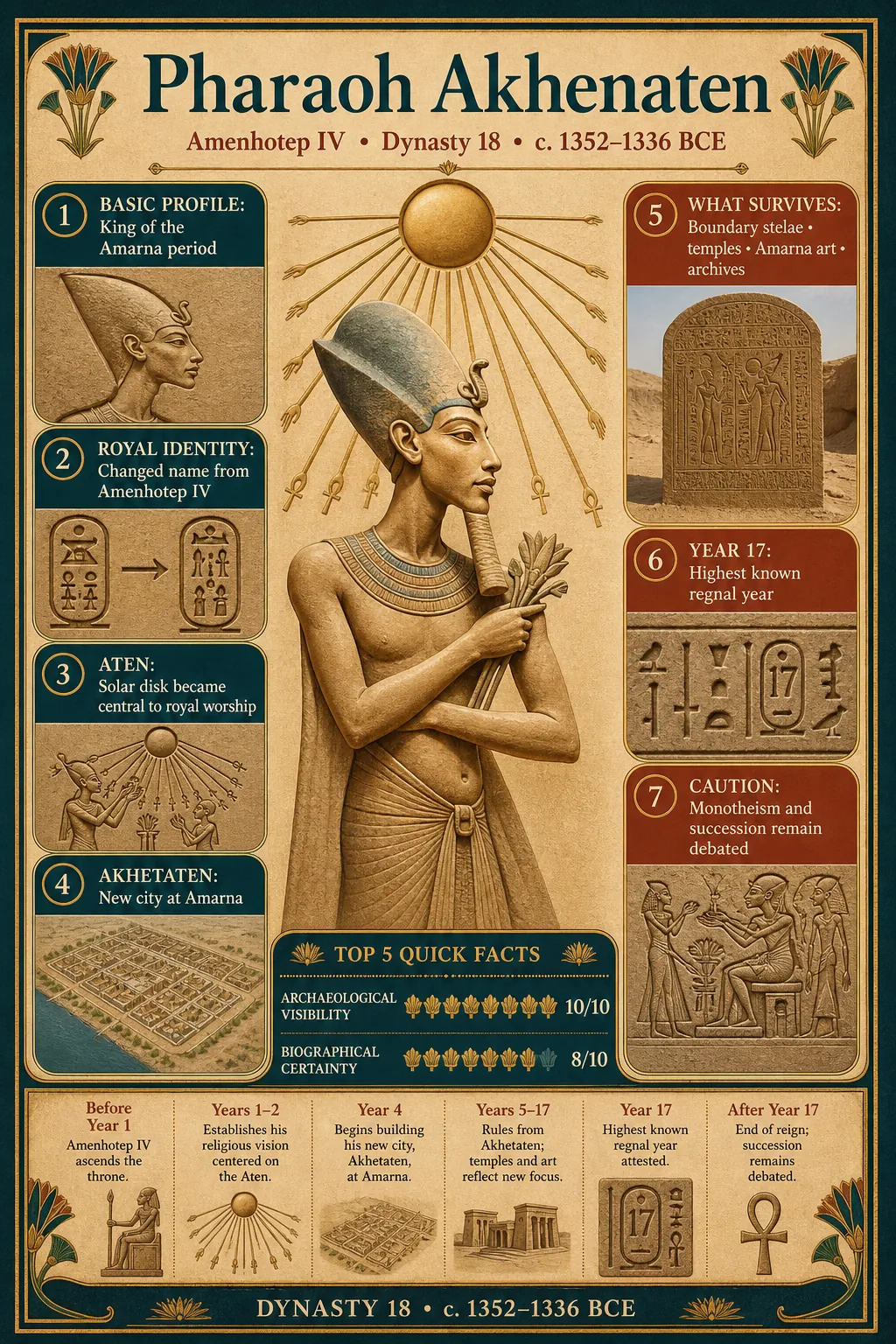
Amenhotep IV, better known by his later name Akhenaten, abandoned Egypt's traditional polytheistic religion in favor of near-exclusive worship of the sun disk Aten, moved the capital to a newly built city at Akhetaten (modern Amarna), and presided over a distinctive artistic style unlike anything before or after in Egyptian art. His reign remains one of the most intensively studied and debated in Egyptology, not least because so much of what followed his death, including the location and even the identity of some of his remains, is still contested. Research: UCL Digital Egypt; Metropolitan Museum.
Dates from: Shaw, Oxford History of Ancient Egypt (2000)
Full profile
Founding Akhetaten and the Amarna revolution
Early in his reign, Amenhotep IV changed his name to Akhenaten, meaning roughly "effective for the Aten," and abandoned the traditional religious capital at Thebes to found an entirely new city, Akhetaten, on a previously unoccupied site in Middle Egypt now known as Amarna. There he promoted the Aten, the visible sun disk, as the primary and eventually near-exclusive object of royal worship, downgrading or actively suppressing the cults of other gods, especially Amun, and closing or defunding many of their temples. His reign also produced a strikingly different royal art style, with elongated features, exaggerated bodily proportions, and unusually informal, intimate scenes of the royal family, a sharp break from the idealized formality of earlier and later Egyptian art that modern scholars call the Amarna style.
Pharaoh Akhenaten
- Dynasty: 18th Dynasty (New Kingdom).
- Title and epithets: Often referred to as the "heretic pharaoh" for his radical departure from traditional Egyptian polytheism.
- Religion: Introduced Atenism, centered on the worship of a single deity, the Aten (the sun disk).
Key figures
- Queen Nefertiti: Akhenaten's Great Royal Wife. She played a crucial role in his religious transformation and is heavily featured in the tomb's surviving reliefs.
- Meketaten: Akhenaten and Nefertiti's daughter, who died young and was buried in a dedicated chamber within Akhenaten's royal tomb.
The royal tomb at Amarna
- Location: Akhetaten (modern Amarna), Middle Egypt. Unlike traditional royal tombs hidden in the Valley of the Kings, this was located far from the Nile in his newly founded capital.
- Design and purpose: Designed as a family tomb meant to house Akhenaten, Nefertiti, and their children, breaking from the tradition of solitary royal burials.
- Afterlife beliefs: Rejected traditional Osiris-based afterlife beliefs, including the weighing of the heart and the Book of the Dead. He believed his spirit would fly out of the tomb to merge with the Aten in the sky and live in a celestial space called the Mansion of the Aten, a heavenly version of Akhetaten where the sun never sets. Despite rejecting traditional beliefs, he did commission shabti figurines, though their exact purpose under Atenism remains debated.
- Surviving art and condition: The tomb has been heavily flooded and intentionally vandalized.
- Sarcophagus: Smashed into hundreds of pieces but now reassembled in the Cairo Museum. Uniquely, the four protective goddesses typically on the corners were replaced entirely by figures of Queen Nefertiti.
- Meketaten's chamber: Features incredibly rare, emotional scenes of Akhenaten and Nefertiti openly weeping and mourning their deceased daughter.
- Burial shafts: Features deep shafts, the purpose of which is debated. Theories include testing stone quality, deterring grave robbers, or catching floodwater.
The KV55 mummy controversy
- Discovery: A fragmented male skeleton was found in tomb KV55 in the Valley of the Kings in 1907. A separate fragmented male body was reportedly found at the Amarna tomb entrance in 1891 but was later lost.
- Identification debate: DNA and CT scans from 2010 linked the body to Tutankhamun, suggesting it is his father, Akhenaten, aged 35 to 45. However, osteological evidence suggests the individual was much younger, around 20 years old, leading some to argue it is the obscure pharaoh Smenkhkare. The true identity remains contested among experts.
Sources for this profile
- Baker, D. D. (2008). The Encyclopedia of the Pharaohs: Volume 1. Stacey International.
- Shaw, I. (Ed.). (2000). The Oxford History of Ancient Egypt. Oxford University Press.
- University College London. Kings of the New Kingdom.
- Reeves, N., & Wilkinson, R. H. (1996). The Complete Valley of the Kings. Thames & Hudson.
- Dodson, A., & Hilton, D. (2004). The Complete Royal Families of Ancient Egypt. Thames & Hudson.
The complete, APA-formatted reference list is on the Academic Sources & Bibliography page.