New Kingdom
Tutankhamun (Nebkheperure)
18th Dynasty · 1550-1295 BCE
 Open full-size illustration →
Source: Shaw, Oxford History of Ancient Egypt (2000)
Background
Tutankhamun ruled for only about nine years and left almost no political mark of his own, yet his intact tomb turned him into the most famous pharaoh in the world. Genetic and skeletal evidence recovered since the 2000s has done far more to explain his short, sickly life than any inscription he left behind. Research: UCL Digital Egypt; Egyptian Mummy Project.
Chronological source: Shaw, Oxford History of Ancient Egypt (2000)
Full profile
The boy king
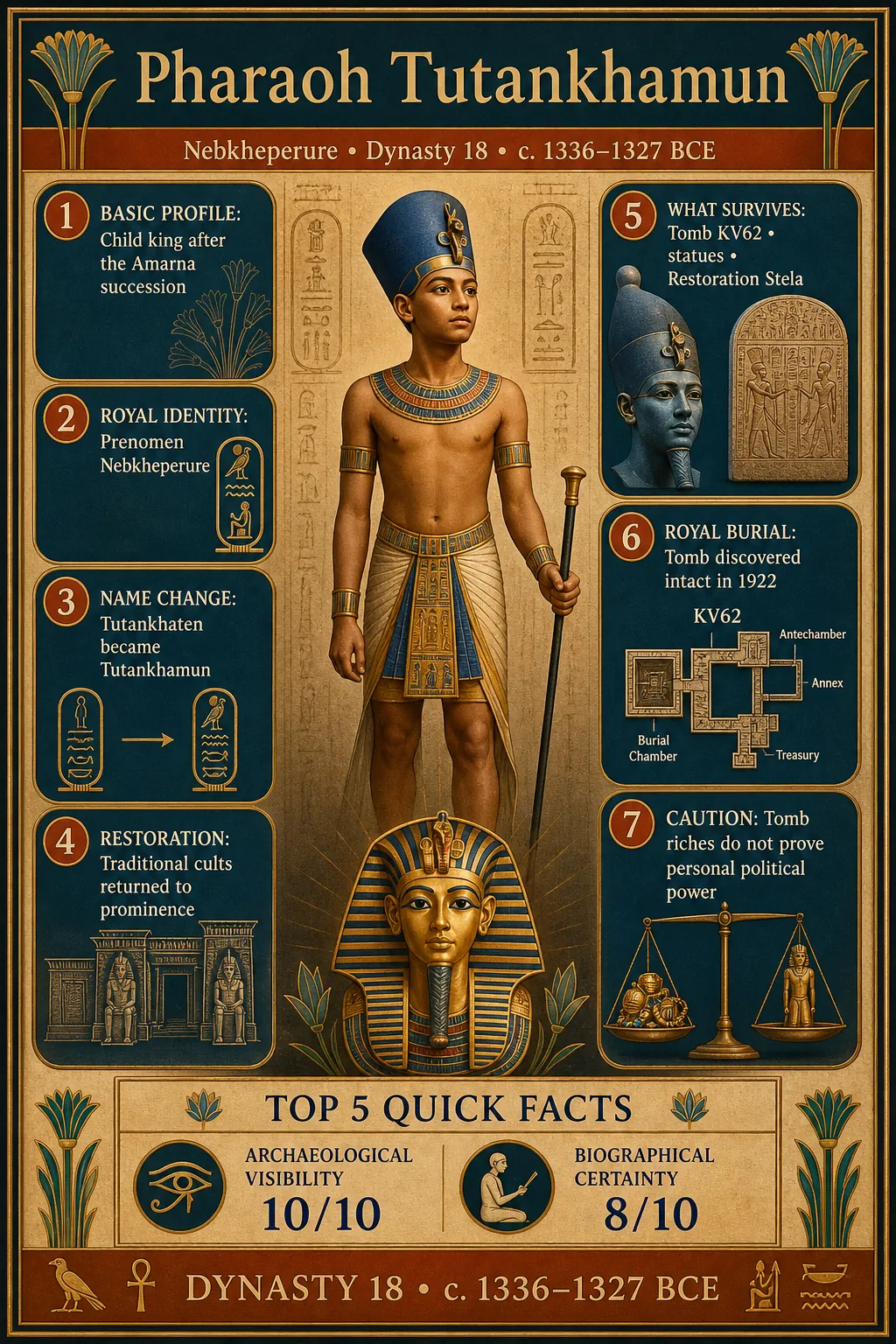
Tutankhamun ascended the throne at just nine years old. Born as Tutankhaten ("Living image of the Aten"), he was the son of Akhenaten and an unidentified royal woman known today as the "Younger Lady." Because he was a child without living elder relatives, he was heavily guided by senior officials, particularly his vizier Ay.
Return to the old gods
Under Ay's influence, the young pharaoh abandoned his father's radical religion and moved the court back to Memphis. He changed his name to Tutankhamun to reflect a renewed devotion to the god Amun. He issued a major decree to repair neglected temples, restore the traditional polytheistic priesthoods, and cast new statues of the old gods using electrum and lapis lazuli.
A frail life and an intact tomb
Tutankhamun suffered from severe health issues, including malaria, sickle cell anemia, and a compound fracture in his leg. He died at the age of 19. His enduring global fame stems entirely from the discovery of his tomb in 1922 by Howard Carter. Because the tomb miraculously escaped ancient looters, it contained over 5,000 intact artifacts, including his famous solid gold funerary mask and innermost coffin.
Two stillborn daughters and an iron blade from the sky
Among the tomb's more poignant discoveries were two small gilded coffins found inside a plain wooden box, each holding the mummified remains of a stillborn daughter, one miscarried at roughly five months and the other close to full term. DNA testing conducted between 2007 and 2009 as part of the Egyptian Mummy Project identified Tutankhamun as the most likely father of both fetuses, though their mother has not been identified. Metallurgical analysis published in 2016 also confirmed that the iron blade of a dagger buried with the king was forged from meteoritic iron, a material ancient Egyptians associated with the heavens and treated as more precious than gold.
Sources for this profile
- Baker, D. D. (2008). The Encyclopedia of the Pharaohs: Volume 1. Stacey International.
- Shaw, I. (Ed.). (2000). The Oxford History of Ancient Egypt. Oxford University Press.
- Carter, H., & Mace, A. (1923). The Tomb of Tut-Ankh-Amen (Vol. 1). Cassell & Company.
- Reeves, N. (1990). The Complete Tutankhamun. Thames & Hudson.
- Hawass, Z., & Vannini, S. (2008). King Tutankhamun: Treasures of the Tomb. Thames & Hudson.
- University College London. Kings of the New Kingdom.
The complete, APA-formatted reference list is on the Academic Sources & Bibliography page.