Ptolemaic Period
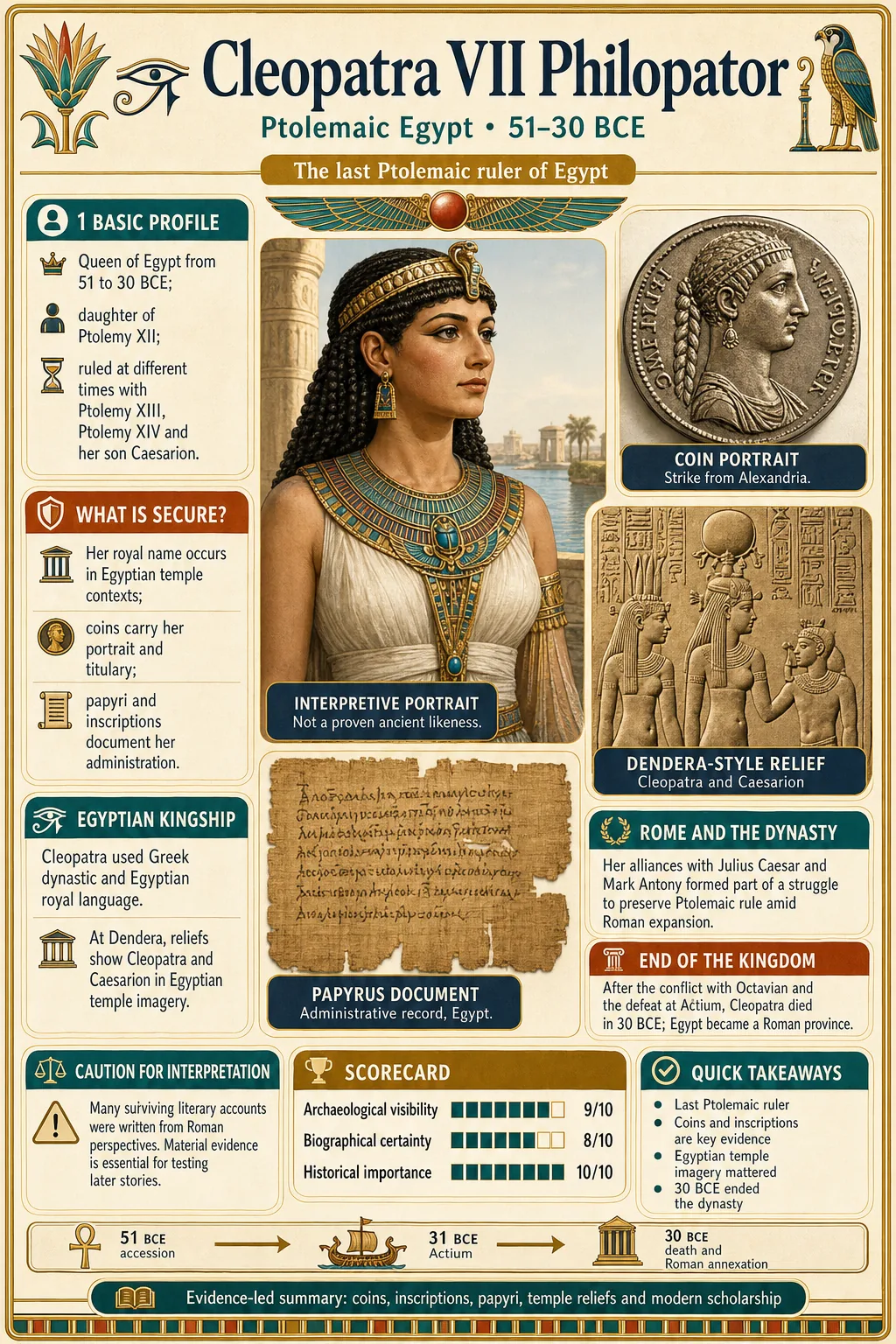
Cleopatra VII Philopator
Ptolemaic kings · 305-30 BCE
 Open full-size illustration →
Source: Shaw, Oxford History of Ancient Egypt (2000)
Background
Cleopatra VII, the last active ruler of ancient Egypt, was the first member of her three-centuries-old Greek dynasty to actually learn the Egyptian language, and the manner of her famous death, a snakebite from a smuggled asp, is doubted by most historians who have studied the physical evidence. Supporting detail: UCL Digital Egypt.
Dates from: Shaw, Oxford History of Ancient Egypt (2000)
Full profile
A queen who finally learned Egyptian
Cleopatra VII came to the throne in 51 BCE as part of a dynasty that had ruled Egypt in Greek since Ptolemy I, three centuries earlier, without most of its kings ever bothering to learn the language of the people they governed. Plutarch specifically credits Cleopatra as the first Ptolemaic ruler to master Egyptian, alongside a reported fluency in several other languages that let her converse directly with foreign envoys from Ethiopia to Parthia without an interpreter, a genuinely unusual level of linguistic effort for a Ptolemaic monarch and part of a broader strategy of presenting herself as a authentically Egyptian pharaoh rather than a distant Greek overlord. Her reign, allied first with Julius Caesar and then Mark Antony, ended when Octavian's forces defeated them at the Battle of Actium in 31 BCE and took Alexandria the following year.
A death scene later historians doubt
The traditional account, recorded by ancient writers including Plutarch, holds that Cleopatra ended her life in August 30 BCE by allowing a venomous asp, reportedly smuggled into her chamber inside a basket of figs, to bite her rather than be paraded through Rome as Octavian's captive. Modern historians and toxicologists have raised serious doubts about the story: Egyptian cobras of the kind implied grow far too large to conceal easily, snake venom of that type kills slowly and unreliably rather than in the swift, clean death ancient sources describe, and Plutarch himself notes that no snake was actually found in the room afterward. A number of modern researchers, including the historian Christoph Schaefer and toxinologist Dietrich Mebs, argue a fast-acting poisonous drug or drink is a far more plausible explanation, meaning one of history's most famous death scenes may be largely legend layered onto a genuine suicide.
Sources for this profile
- Shaw, I. (Ed.). (2000). The Oxford History of Ancient Egypt. Oxford University Press.
- Dodson, A., & Hilton, D. (2004). The Complete Royal Families of Ancient Egypt. Thames & Hudson.
- University College London. Kings of Ptolemaic Egypt.
- UCLA Encyclopedia of Egyptology. Chronology. UCLA.
The complete, APA-formatted reference list is on the Academic Sources & Bibliography page.