Old Kingdom
Djoser (Netjerikhet)
3rd Dynasty · 2686-2613 BCE
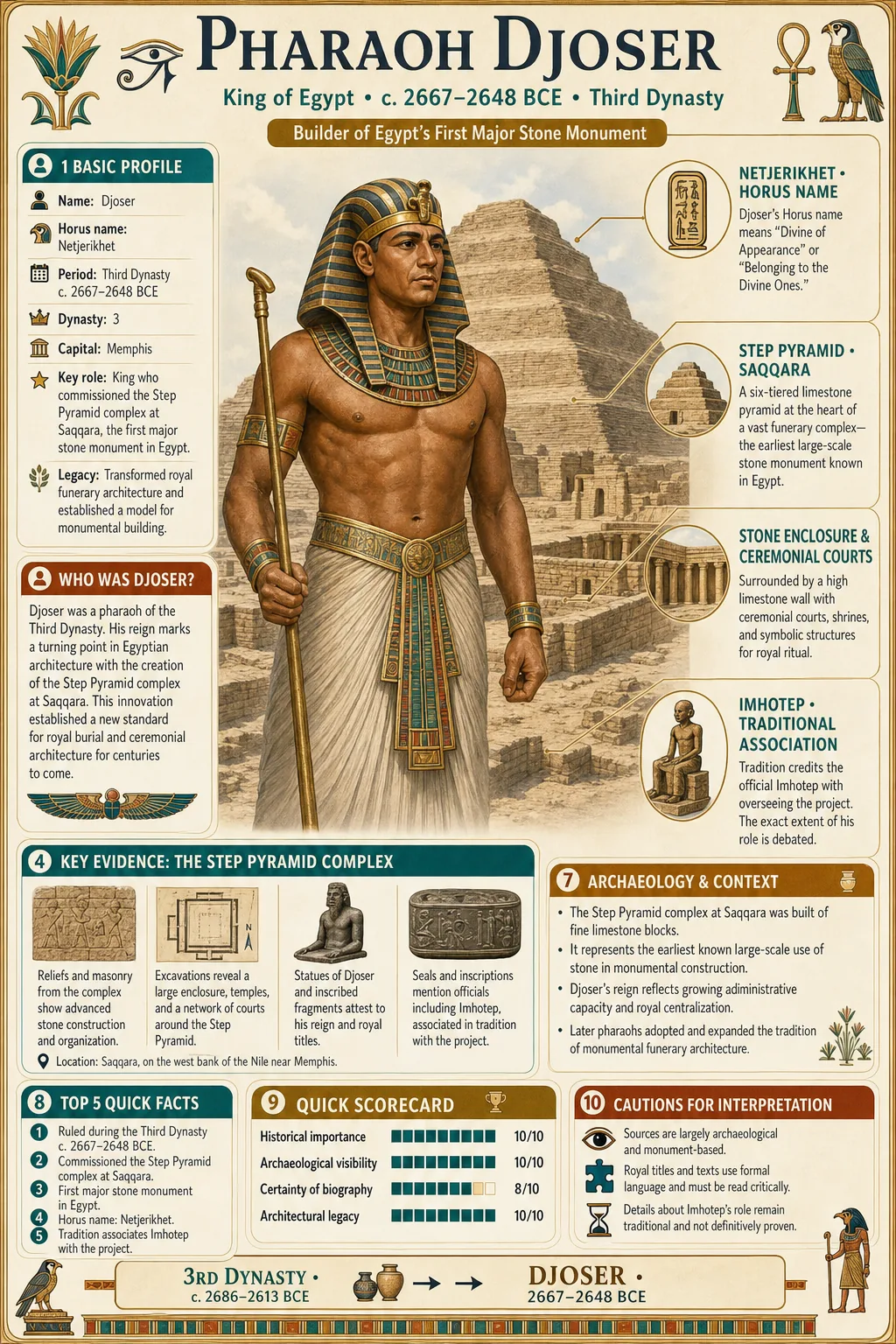 Open full-size illustration →
Source: Shaw, Oxford History of Ancient Egypt (2000)
Background
Djoser, whose Horus name was Netjerikhet, is the best-attested ruler of Dynasty 3. His Step Pyramid complex at Saqqara is Egypt’s first major stone monument and transformed earlier royal funerary architecture into an enormous enclosed ceremonial landscape. The complex is traditionally associated with the official Imhotep, although the precise extent of Imhotep’s role is debated. Djoser’s monuments show the early Old Kingdom’s capacity to mobilise stone, labour and administration. His place in the dynasty is secure, even though absolute dates and some family relationships remain debated. Research: Metropolitan Museum; UCL Digital Egypt.
Reign dates: Shaw, Oxford History of Ancient Egypt (2000)
Full profile
Restoring stability
Djoser is universally recognized as the founder of the Old Kingdom. Following the sectarian conflicts and northern revolts that defined the Second Dynasty, Djoser brought immediate stability to Egypt. This unified control over the northern delta region allowed him to launch state-sponsored mining expeditions into the Sinai Peninsula to extract valuable metals and turquoise.
The first stone pyramid
Djoser abandoned the ancestral royal cemetery of Abydos and relocated his mortuary complex to Saqqara, just outside the capital of Memphis. Here his chief architect and vizier, Imhotep, designed the Step Pyramid. Standing nearly 63 meters tall and consisting of six stacked mastabas, it was the first large-scale stone structure in human history. Underneath the pyramid, archaeologists discovered burial chambers for the king and eleven members of his family.
A lasting legacy
The Turin Canon assigns Djoser a relatively short reign of 19 years, yet his legacy endured for millennia. He was one of the few ancient pharaohs whose memory remained highly revered by later generations. When the scribe of the Turin Canon recorded Djoser's name, he broke convention by writing it in red ink instead of black to signify the king's profound historical importance.
A dummy palace for eternity
Beyond the pyramid itself, the enclosure Imhotep designed for Djoser includes a large open court intended for the king's Heb-Sed jubilee festival to be performed eternally in the afterlife, flanked by rows of solid, non-functional dummy chapels carved in stone to imitate the light wood, reed, and matting shrines used in actual Sed-festival ceremonies. This translation of temporary ritual architecture into permanent stone is regarded by Egyptologists as one of Imhotep's most significant conceptual achievements, since it shows Egyptian builders using the new medium of cut stone to make an entire ceremonial cityscape permanent rather than just a single tomb.
The much later Famine Stela
A text known as the Famine Stela, carved on a rock on the island of Sehel near Aswan, purports to record a royal decree of Djoser describing a seven-year famine caused by a failure of the Nile flood, and his consultation of the god Khnum and the priest Imhotep to resolve it. The inscription dates on stylistic grounds to the Ptolemaic period, roughly two thousand years after Djoser's reign, and is understood as a much later composition using his already-legendary name to lend authority to a contemporary land grant, rather than a genuine record from his own time.
Sources for this profile
- Baker, D. D. (2008). The Encyclopedia of the Pharaohs: Volume 1. Stacey International.
- Shaw, I. (Ed.). (2000). The Oxford History of Ancient Egypt. Oxford University Press.
- Dodson, A., & Hilton, D. (2004). The Complete Royal Families of Ancient Egypt. Thames & Hudson.
- Leprohon, R. J. (2013). The Great Name: Ancient Egyptian Royal Titulary. Society of Biblical Literature.
- University College London. Digital Egypt for Universities.
The complete, APA-formatted reference list is on the Academic Sources & Bibliography page.