Early Dynastic Period
Narmer (Menes?)
1st Dynasty · c.3000-2890 BCE
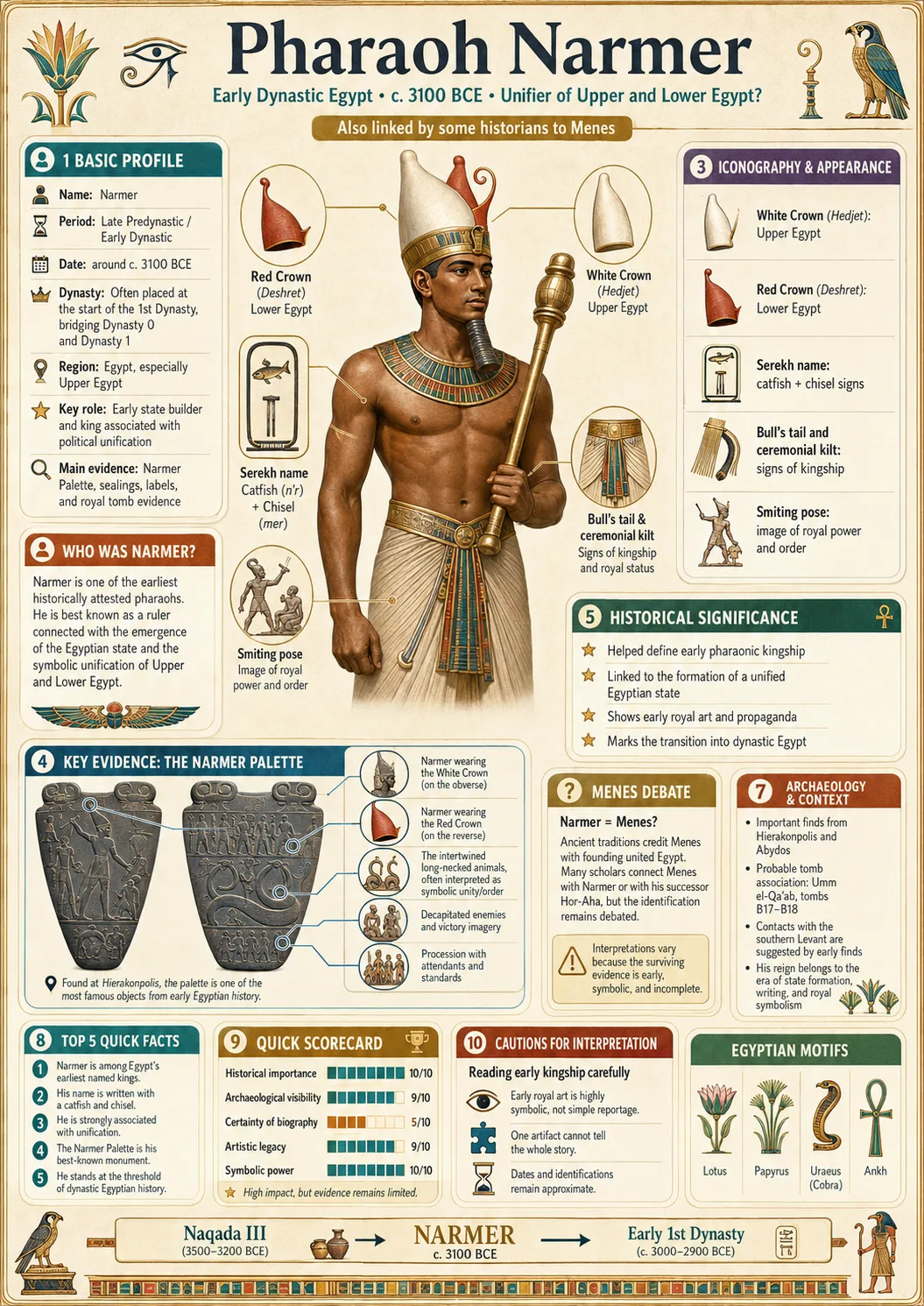 Open full-size illustration →
Source: Shaw, Oxford History of Ancient Egypt (2000)
Background
Narmer is conventionally placed at the start of Dynasty 1, although some scholars treat him as the last “Dynasty 0” ruler and his identity with the later legendary Menes remains unproven. His name occurs widely, including at Abydos (tombs B17–18), Hierakonpolis and sites in the southern Levant. The Narmer Palette depicts him in the White and Red Crowns and is a major source for early royal iconography, but it should not be read as a literal record of a single conquest. His reign belongs to the formative phase of a highly centralised Egyptian state. Background from: UCL Digital Egypt.
Reign dates: Shaw, Oxford History of Ancient Egypt (2000)
Full profile
The unifier of two lands
Narmer is widely recognized as the king who unified Upper and Lower Egypt, establishing the First Dynasty. The famous Narmer Palette provides crucial early evidence of this, depicting him wearing the White Crown of Upper Egypt on one side and the Red Crown of Lower Egypt on the other. He is heavily associated with the legendary king Menes, whom ancient chroniclers credit with founding the capital city of Memphis to control the newly unified state.
The Narmer Palette
The palette itself was recovered in 1898 by James Quibell at Hierakonpolis, in a cache known as the "Main Deposit" alongside other ceremonial objects. Carved in low relief on both faces, it shows Narmer smiting a bound enemy with a raised mace, inspecting decapitated captives, and — on the reverse — two long-necked serpopards whose intertwined necks form a circular depression once used for grinding cosmetics. Egyptologists remain divided on how literally to read the imagery: some treat it as a record of a specific military campaign that achieved unification, others as royal propaganda expressing an ideology of conquest and order that may have consolidated a process already largely underway.
Evidence beyond Egypt's borders
Narmer's serekh — his name enclosed in a rectangular frame representing a palace facade, topped by the Horus falcon — has been found on pottery and seal impressions well beyond the Nile Valley, including at southern Levantine sites such as Tel Erani and En Besor. This distribution points to early trade contacts or a projection of Egyptian influence into Canaan at the very start of the dynastic era. His tomb at Abydos (designated B17–18 in the Umm el-Qa'ab royal necropolis) sits alongside those of his immediate successors, though — as the page description notes — some scholars place him at the end of a preceding "Dynasty 0" rather than as the first king of Dynasty 1, and his equation with the semi-legendary Menes of later king lists remains unproven rather than settled fact.
Sources for this profile
- Baker, D. D. (2008). The Encyclopedia of the Pharaohs: Volume 1. Stacey International.
- Shaw, I. (Ed.). (2000). The Oxford History of Ancient Egypt. Oxford University Press.
- Dodson, A., & Hilton, D. (2004). The Complete Royal Families of Ancient Egypt. Thames & Hudson.
- Leprohon, R. J. (2013). The Great Name: Ancient Egyptian Royal Titulary. Society of Biblical Literature.
- University College London. Digital Egypt for Universities.
The complete, APA-formatted reference list is on the Academic Sources & Bibliography page.