New Kingdom
Ramesses II (Usermaatre Setepenre)
19th Dynasty · 1295-1186 BCE
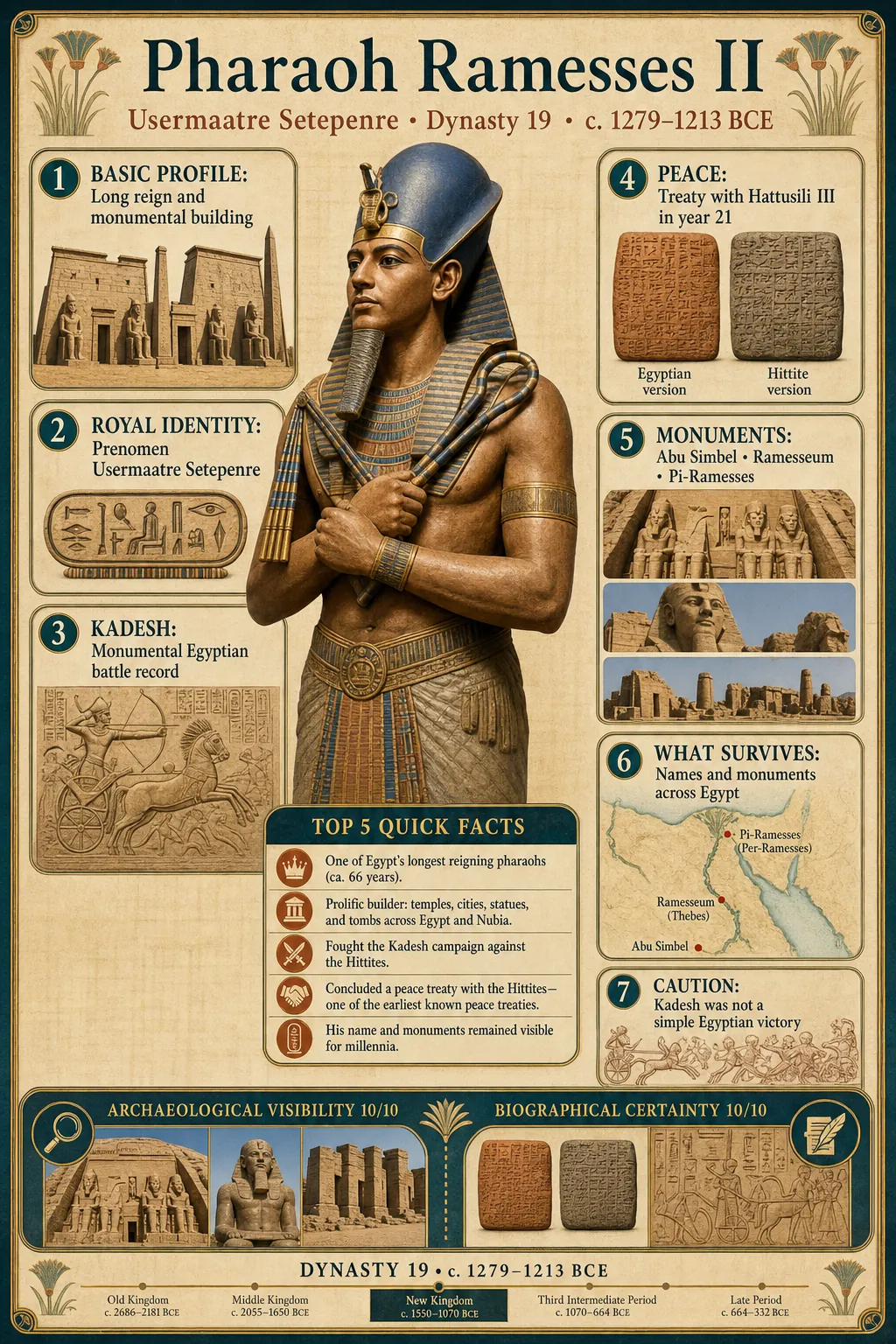 Open full-size illustration →
Source: Shaw, Oxford History of Ancient Egypt (2000)
Background
Ramesses II reigned for roughly 66 years, longer than almost any other pharaoh, and used that time to build more monuments, father more children, and fight more campaigns than any ruler of the New Kingdom, becoming the template later generations imagined when they pictured a great pharaoh. Research: UCL Digital Egypt; Theban Mapping Project.
Dating: Shaw, Oxford History of Ancient Egypt (2000)
Full profile
Overview
Ramses II ("Ramses the Great"), throne name Usermaatre Setepenre, was the dominant figure of the 19th Dynasty. He reigned about 66 years (c. 1279–1213 BCE) and lived into his early nineties — an extraordinary span that made him a model of the great pharaoh for later generations.
Lineage & family
- Origin: a non-royal military family from the Nile Delta (the Avaris region).
- Grandfather: Ramses I, chosen as successor by Horemheb.
- Father: Seti I
- Mother: Queen Mut-Tuya, honoured at the Ramesseum.
- Great Royal Wives: Nefertari (his favourite, buried in the exquisite QV66), Isetnofret, the Hittite princess Maathorneferure (married to seal the peace treaty), and his daughters Meritamen and Bintanath.
- Children: he fathered well over 100 children. Notable sons include Khaemwaset — an early "Egyptologist" who restored Old Kingdom monuments — and Merneptah, who succeeded him.
Physical description
Surviving remains and inscriptions suggest he was tall for his time, with a prominent hooked nose; analysis indicates reddish hair, henna-tinted in old age. In later life he suffered from severe arthritis, dental disease and hardened arteries.
Military campaigns
- Sherden pirates (Year 2): defeated and then absorbed into his royal guard.
- Battle of Kadesh (Year 5, c. 1274 BCE): against the Hittites under Muwatalli II. Ambushed through false intelligence, the battle ended in a draw but was celebrated on temple walls as a personal triumph.
- Siege of Dapur (Year 8): captured this Hittite stronghold in Syria using early siege tactics.
- Treaty of Kadesh (Year 21, 1259 BCE): with Hattusili III — the earliest surviving peace treaty in recorded history.
Monuments
- Pi-Ramesse: a vast new capital city in the Delta.
- Abu Simbel: two rock-cut temples in Nubia — the Great Temple to himself and the gods, the Small Temple to Nefertari and Hathor.
- The Ramesseum: his mortuary temple at Luxor.
- Karnak & Luxor: he completed the Great Hypostyle Hall at Karnak and expanded Luxor Temple.
- KV5: an enormous multi-chamber tomb built for his many sons.
Myths & corrections
- Not the pharaoh of the Exodus: there is no archaeological or chronological evidence linking him to the biblical Exodus; the association largely comes from twentieth-century film.
- Statue "usurpation": re-inscribing older statues was a standard way to connect a ruler to earlier kings, not simple vandalism.
Death & discovery
- Originally buried in KV7. After ancient tomb-robbing, priests moved his mummy to the Deir el-Bahari royal cache (DB320), rediscovered in 1881.
- In 1976 his mummy was flown to Paris to treat a fungal infection (the popular "passport" story is a myth).
Research: Pharaoh Triumphant; Shaw, Oxford History of Ancient Egypt.
Sources for this profile
- Baker, D. D. (2008). The Encyclopedia of the Pharaohs: Volume 1. Stacey International.
- Shaw, I. (Ed.). (2000). The Oxford History of Ancient Egypt. Oxford University Press.
- University College London. Kings of the New Kingdom.
- Reeves, N., & Wilkinson, R. H. (1996). The Complete Valley of the Kings. Thames & Hudson.
- Dodson, A., & Hilton, D. (2004). The Complete Royal Families of Ancient Egypt. Thames & Hudson.
The complete, APA-formatted reference list is on the Academic Sources & Bibliography page.