Early Dynastic Period
Senedj
2nd Dynasty · 2890-2686 BCE
 Open full-size illustration →
Source: Shaw, Oxford History of Ancient Egypt (2000)
Background
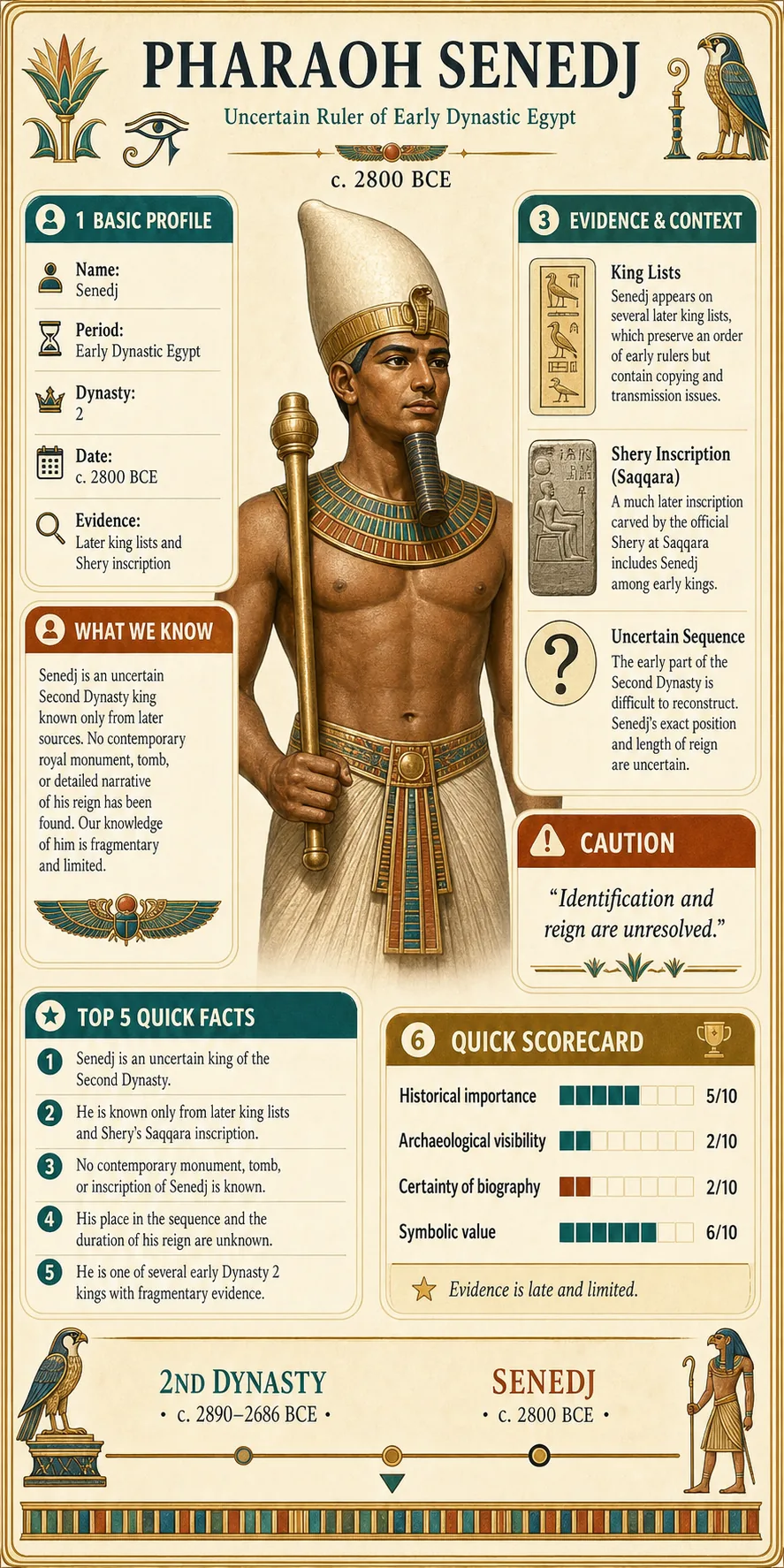
Senedj is known primarily from later king lists and from a much later Saqqara inscription associated with the official Shery, rather than from a secure contemporary royal monument. Attempts to identify Senedj with one of the fragmentary Second Dynasty names found on vessels remain unresolved. Consequently, his placement and historical identity are less certain than the simple list format suggests. He is generally retained in reconstructions of the dynasty, but no confident narrative of his reign, territory or burial can be written from the existing evidence. Research: UCL Digital Egypt; Early Dynastic king lists.
Dates from: Shaw, Oxford History of Ancient Egypt (2000)
Full profile
An obscure successor
Senedj is an incredibly obscure figure in the Second Dynasty. Almost no material evidence exists from his time in power, though his name was preserved and recorded on several later Egyptian king lists.
The priest Shery's stela
The single most important piece of evidence for Senedj is a limestone stela belonging to a priest named Shery, dated on stylistic grounds to the Fourth Dynasty — a good four centuries or more after Senedj's own lifetime. Shery describes himself as a priest responsible for the mortuary cults of both Senedj and the later king Peribsen, which shows that a formal offering cult in Senedj's name was still being maintained generations later, even though no contemporary monument from his actual reign has been identified. This kind of posthumous cult evidence, common for early kings, confirms that a ruler existed and was remembered, without supplying any details of what he actually did.
An unresolved place in the sequence
Manetho's epitomizers assign a king called Sethenes, generally equated with Senedj, a reign of over forty years, a figure modern Egyptologists treat with considerable skepticism given the almost total absence of contemporary material to support it. Some scholars have proposed identifying Senedj with one of the few fragmentary royal names attested on vessels from this part of the dynasty, but no such identification has achieved consensus, leaving Senedj as one of the clearest examples in the Second Dynasty of a name whose place in Egyptian memory is secure while almost everything else about the man remains unknown.
Sources for this profile
- Baker, D. D. (2008). The Encyclopedia of the Pharaohs: Volume 1. Stacey International.
- Shaw, I. (Ed.). (2000). The Oxford History of Ancient Egypt. Oxford University Press.
- Dodson, A., & Hilton, D. (2004). The Complete Royal Families of Ancient Egypt. Thames & Hudson.
- Leprohon, R. J. (2013). The Great Name: Ancient Egyptian Royal Titulary. Society of Biblical Literature.
- University College London. Digital Egypt for Universities.
The complete, APA-formatted reference list is on the Academic Sources & Bibliography page.